
 EN
EN
 Deutsch
 polski
 русский
 українська

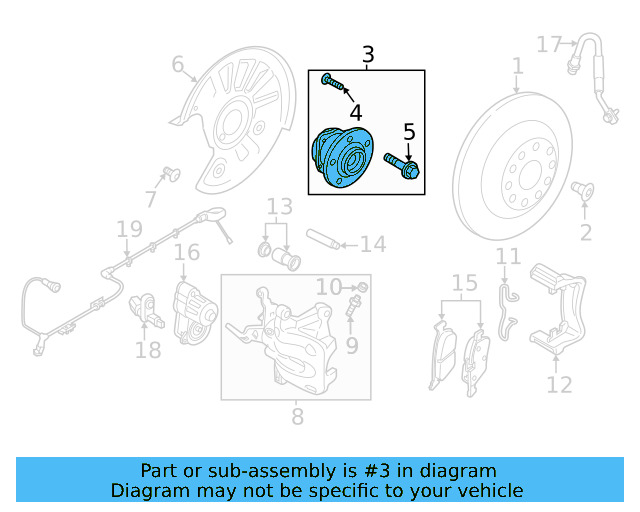
Wheel Bearing 5Q0-407-621-D
Available in stores 11 offers
Vehicle fitment 29 vehicles
Technical specifications
| Fitting Position | Front Axle |
|---|---|
| Outer Diameter | 136 mm |
| Hub Bore Diameter | 85 mm |
| Compatible Brake Disc Size | 310 mm × 22 mm |
| Material | High-strength steel |
| ABS Sensor | Integrated reluctor ring |
| Axle Nut Torque | 200 Nm |
| Hub Mounting Bolt Torque | 70 Nm |
| Wheel Lug Nut Torque | 120 Nm |
| OEM Part Number | 5Q0 407 621 D |
How to replace the Wheel Bearing
Replacing the 5Q0407621D front wheel hub and bearing assembly is a straightforward bolt-on procedure for a competent DIY mechanic with proper tools. The following steps outline the general process; always consult your vehicle's official service manual for model-specific torque values and procedures before beginning work.
-
Prepare the Vehicle
Park on a level surface and engage the parking brake. Loosen the wheel lug nuts slightly while the vehicle is still on the ground. Lift the vehicle with a floor jack and secure it on jack stands at the designated chassis jacking points. Remove the wheel completely.
-
Remove the Brake Caliper
Unbolt the brake caliper from the caliper bracket and suspend it using a wire hook or bungee cord from the spring. Do not allow it to hang by the brake hose, as this can damage the hydraulic line.
-
Remove the Brake Rotor
Slide the brake rotor off the hub. If it is seized, use a rubber mallet or a rotor removal screw to free it gently. Set the rotor aside safely.
-
Disconnect the ABS Sensor and Remove the Axle Nut
Unplug the ABS sensor electrical connector. Remove the large center axle nut — note this is typically a high-torque fastener (200 Nm) and may require an impact wrench or breaker bar. Discard the old axle nut as it is a single-use prevailing torque nut.
-
Unbolt and Extract the Hub Assembly
Remove the hub mounting bolts securing the assembly to the steering knuckle. Carefully pull the hub assembly off the CV axle shaft. If resistance is encountered, use a hub puller tool — avoid striking the assembly with a hammer.
-
Install the New Hub Assembly
Slide the new 5Q0407621D hub assembly onto the CV axle shaft and align it with the steering knuckle mounting holes. Thread in and torque the hub mounting bolts to 70 Nm. Reconnect the ABS sensor electrical connector. Install a new axle nut and torque to 200 Nm.
-
Reassemble Brake Components
Reinstall the brake rotor onto the new hub. Reposition the brake caliper and bracket, torquing the caliper bolts to the manufacturer's specification. Verify the brake hose and ABS wiring are routed correctly and free from pinch points.
-
Final Torque and Road Test
Reinstall the wheel and hand-tighten the lug nuts. Lower the vehicle to the ground and torque the lug nuts to 120 Nm in a star pattern. Road-test the vehicle at low speed first, checking for any unusual noises or vibrations, and verify the ABS warning light is not illuminated.
Signs of a worn part
-
Grinding or Humming Noise
A persistent grinding, humming, or rumbling noise from the front wheel area — often changing pitch with vehicle speed or when changing lanes — is the most common indicator of a failing wheel bearing.
-
Wheel Vibration or Wobble
Excessive play or wobble felt in the steering wheel or through the vehicle chassis at speed may indicate bearing wear allowing unwanted wheel movement.
-
Uneven or Accelerated Tire Wear
A compromised bearing can allow slight misalignment of the wheel, leading to abnormal or uneven tire tread wear patterns that are not explained by alignment or inflation issues.
-
ABS Warning Light Illuminated
Because this assembly includes an integrated ABS reluctor ring, a damaged or corroded bearing can disrupt the wheel speed signal and trigger the ABS or traction control warning light on the dashboard.
-
Loose or Rough Steering Feel
Advanced bearing failure can introduce looseness or roughness into the steering feel, particularly when turning or at highway speeds, as the hub no longer rotates smoothly or concentrically.
Replacement intervals
There is no fixed mileage replacement schedule for this sealed hub-and-bearing assembly. Replace it when symptoms of wear or failure are present, or when physical inspection reveals excessive play or damage. Always inspect during any brake service or suspension work.
Frequently asked questions
Is 5Q0407621D a sealed bearing assembly or does it require pressing?
The 5Q0407621D is a complete bolt-on hub-and-bearing assembly. The bearing is permanently sealed within the unit and does not need to be pressed separately. The entire assembly bolts directly to the steering knuckle, making replacement possible without a hydraulic press.
Will this part fit my Audi A3 or only Volkswagen models?
This OEM part number is shared across multiple Volkswagen Group brands, including Audi A3 (2022–2024), VW Golf R and Arteon (2019–2024), Škoda Octavia (2019–2024), and SEAT Leon (2019–2024). However, fitment can vary by drivetrain and production date — always verify using your vehicle's VIN before ordering.
Does this hub assembly include the ABS sensor, or do I need to buy it separately?
The 5Q0407621D includes an integrated ABS reluctor ring built into the hub assembly. You will need to reconnect your existing ABS sensor electrical connector to the new hub — the external sensor itself is a separate component and is not included with this assembly.
Can I reuse my existing axle nut when installing this hub?
No. The axle nut used on these VW Group vehicles is a prevailing torque (single-use) fastener. Its locking properties are compromised after being removed. Always install a new axle nut and torque it to 200 Nm — reusing the old nut is a safety risk.
How do I know if FAG 7136109800 or the OEM 5Q0407621D is the better buy?
FAG (part of Schaeffler Group) is an OEM bearing supplier to Volkswagen Group, meaning the bearings inside your factory-installed hub were likely manufactured by FAG. The FAG 7136109800 is our recommended aftermarket equivalent and offers comparable quality to the OEM unit, often at a lower price. The genuine VW/Audi part is the safest option for warranty repairs or where exact OEM provenance is required.
Do I need a wheel alignment after replacing the front hub bearing?
Replacing only the hub and bearing assembly typically does not require a wheel alignment, as the steering knuckle and suspension geometry are not disturbed. However, if any suspension, tie rod, or control arm components were disconnected during the repair, a wheel alignment check is strongly recommended.
Found an error?
Help us improve — if you've spotted an error on the site or in the data, let us know and we'll fix it as soon as possible.