
 UK
UK
 Deutsch
 English
 polski
 русский

Timing Belt 04E-109-119-F
If the timing belt becomes worn or damaged, it can lead to severe engine issues, including misfiring, a loss of power, or even catastrophic engine failure. Signs of a failing timing belt include unusual noises, visible wear, or engine performance inconsistencies, making timely replacement vital to avoid costly repairs.
Choosing this OEM timing belt with part number 04E-109-119-F means opting for a part manufactured to the original standards. This ensures proper fit and function, reducing the likelihood of premature wear or failure associated with non-certified replacements.
Доступно в магазинах 55 пропозицій
Сумісність з автомобілями 72 автомобілі
Технічні характеристики
| OEM Part Number | 04E-109-119-F |
|---|---|
| Part Type | Timing Belt (Tooth Belt) |
| Belt Length | 1,141 mm |
| Belt Width | 20 mm |
| Number of Teeth | 163 |
| Material | High-strength rubber with embedded reinforcing fibers |
| Tensioner Pulley Torque | 20 Nm + 45° |
| Idler Pulley Torque | 50 Nm + 90° |
| Crankshaft Pulley Torque | 10 Nm + 90° |
| Compatible Engine Types | 1.4L TSI, 1.5L TSI, 1.4L TFSI |
Як замінити Timing Belt
Timing belt replacement on VW Group 1.4L/1.5L TSI engines is a precision procedure requiring proper tooling, including engine locking/alignment pins. Always replace the tensioner and idler pulleys simultaneously and refer to your vehicle-specific workshop manual for exact procedures and torque specifications.
-
Preparation and Safety
Disconnect the negative battery terminal. Allow the engine to cool completely. Remove engine top covers and any accessories, brackets, or ancillary components blocking access to the timing cover.
-
Set Engine to TDC and Lock Timing
Rotate the engine clockwise to Top Dead Center (TDC) on cylinder 1. Align the timing marks on the crankshaft sprocket and camshaft sprocket(s). Insert the appropriate VW timing lock pins/tools to secure the crankshaft and camshaft in the correct position.
-
Remove Timing Cover and Accessories
Remove the crankshaft pulley bolt and pulley. Remove the upper and lower timing belt covers to expose the belt, tensioner, and idler pulleys.
-
Release Tension and Remove Old Belt
Loosen the tensioner pulley to relieve belt tension. Slide the old timing belt off the crankshaft sprocket, camshaft sprocket(s), tensioner, and idler. Do not rotate the engine with the belt removed.
-
Replace Tensioner and Idler Pulleys
Install the new tensioner pulley and idler pulley. Torque the idler pulley to 50 Nm + 90° and the tensioner to 20 Nm + 45° as specified. Replacing these components now prevents premature failure.
-
Install New Timing Belt
Route the new 04E-109-119-F belt over the crankshaft sprocket first, then camshaft sprocket(s), idler, and tensioner — following the manufacturer's routing direction. Ensure all timing marks remain aligned with locking tools in place.
-
Tension and Torque
Activate or set the tensioner per the workshop manual procedure. Torque the crankshaft pulley bolt to 10 Nm + 90°. Remove all timing lock pins/tools.
-
Verify Timing and Reassemble
Manually rotate the engine two full clockwise revolutions by hand and recheck all timing marks for correct alignment. Reinstall timing covers, crankshaft pulley, and all removed accessories. Reconnect the battery, start the engine, and check for any abnormal noise or warning lights.
Ознаки зношеної деталі
-
Engine Won't Start
A snapped timing belt prevents crankshaft-to-camshaft synchronization entirely, resulting in a no-start condition. On this interference engine, a broken belt typically causes severe internal engine damage.
-
Engine Misfires or Rough Running
A stretched or worn belt can cause slight timing drift, leading to misfires, rough idle, and reduced power as valve and ignition events fall out of sync.
-
Ticking or Slapping Noise from Engine
A failing or loose timing belt may produce a rhythmic ticking or slapping noise from the front of the engine, particularly at startup or low RPM.
-
Oil Leaks Near Timing Cover
Deteriorating timing belt seals or a worn belt that has been contaminated with oil from a failing camshaft or crankshaft seal can result in visible oil around the timing cover area.
-
Check Engine Light / Camshaft Position Fault
A stretched belt causing camshaft timing deviation may trigger fault codes related to camshaft or crankshaft position sensor correlation, illuminating the check engine light.
Періодичність заміни
Whichever limit — mileage or time — is reached first should trigger replacement. This engine is an interference design; a belt failure will result in contact between pistons and valves, causing catastrophic engine damage. Do not extend intervals beyond manufacturer specifications.
Часті запитання
Is the 04E-109-119-F a timing belt or a timing chain?
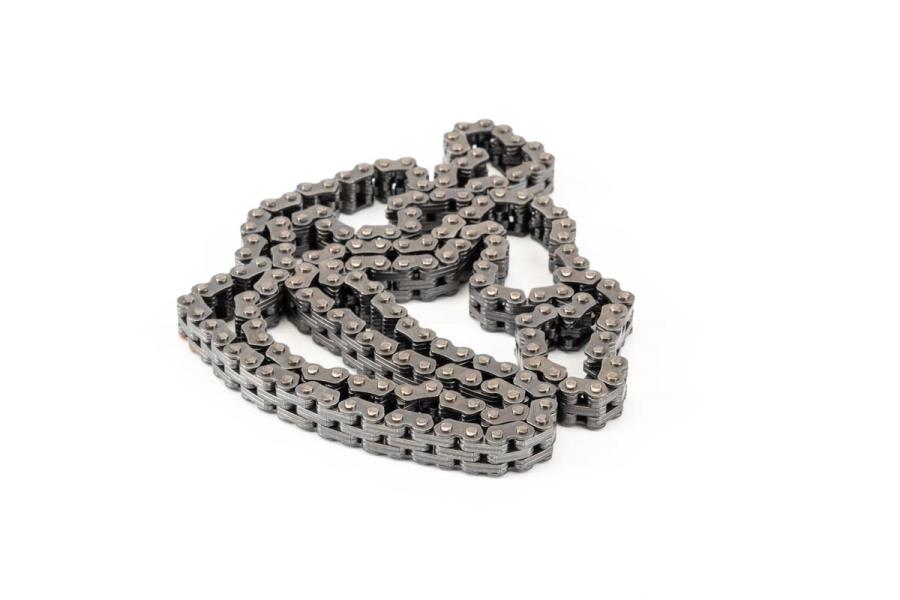
It is a timing belt (tooth belt). The 1.4L TSI and 1.5L TSI engines it fits use a rubber toothed belt drive system, not a chain. This means it is a wear item with a defined replacement interval, unlike a chain which is typically designed to last the life of the engine.
What vehicles does the 04E-109-119-F fit?
This belt is compatible with select Volkswagen and Audi models, including the VW Golf (2019–2021) with 1.4L TSI, VW Golf SportWagen (2019) with 1.4L TSI, VW Jetta (2016–2021) with 1.4L TSI, VW Jetta Hybrid (2013–2014) with 1.4L TSI, VW Taos with 1.5L TSI, and the Audi A3 Sportback e-tron (2016–2018) with 1.4L TFSI. Always verify your engine code before ordering.
Should I buy just the belt or a complete timing belt kit?
It is strongly recommended to purchase a complete timing belt kit that includes the tensioner pulley and idler pulley. Since the labor to access the timing belt is the same whether you replace one component or all of them, replacing the pulleys at the same time prevents a premature return job if a pulley fails on the new belt.
Is the Continental CT1167 a safe alternative to the OEM 04E-109-119-F?
Yes. Continental is an OEM-level supplier to Volkswagen Group and the CT1167 matches the OEM specifications in length (1,141 mm), width (20 mm), and tooth count (163). It is the top recommended aftermarket equivalent for this application.
What happens if I don't replace the timing belt on schedule?
The 1.4L/1.5L TSI is an interference engine, meaning the pistons and valves occupy overlapping space in the cylinder — timed precisely by the belt. If the belt snaps or skips teeth, the pistons will strike the open valves, causing bent valves, damaged pistons, and potentially a destroyed cylinder head. This repair can cost several times more than a preventive belt replacement.
Are the superseded part numbers 04E-109-119-C and 04E-109-119-G the same belt?
These are earlier revision numbers that have been superseded by the 04E-109-119-F. The F revision is the current OEM part and represents any engineering updates made since those earlier suffixes. If you are offered a -C or -G part as new stock, confirm it meets current specifications; the -F is the preferred replacement.
Знайшли помилку?
Допоможіть нам стати кращими — якщо ви помітили помилку на сайті або в даних, повідомте нас, і ми виправимо її якнайшвидше.